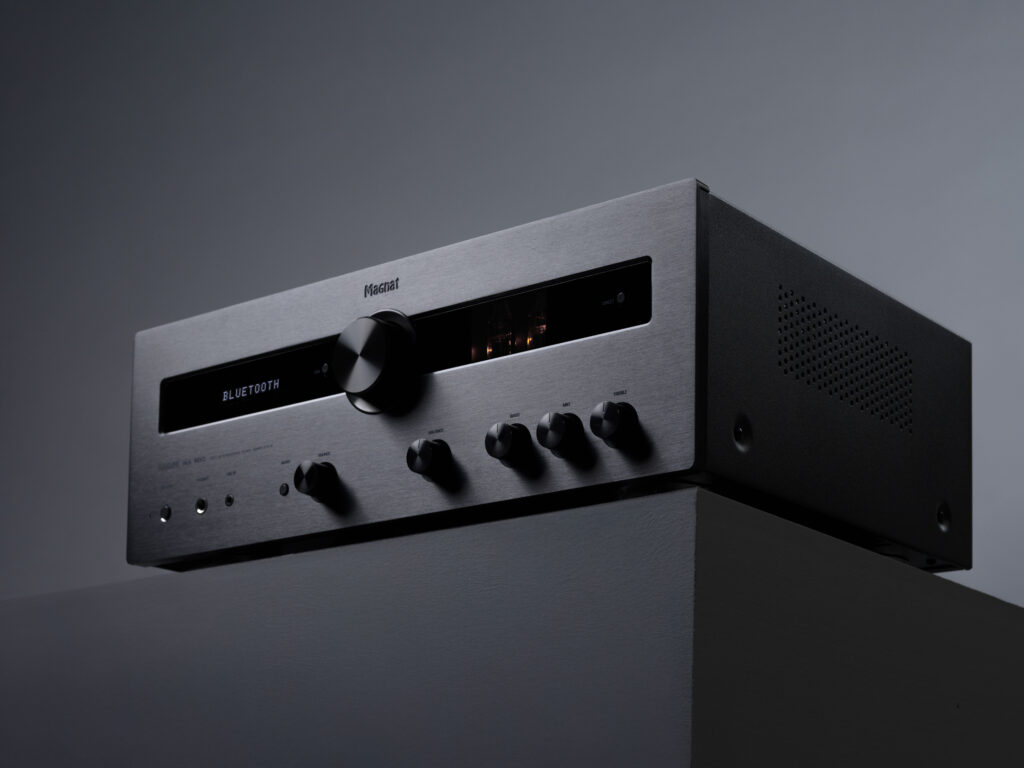
Whether you’re building your first hi-fi system or upgrading your home cinema, you’ve probably come across the term amplifier—or amp. But what exactly does an amplifier do? Do you need one? And how do you choose the right type?
In this article, we’ll explain what an amplifier is, how it works, and when it’s essential for your audio system.
What is an amplifier?
An amplifier is an electronic device that boosts audio signals. It takes a weak signal from a source like your smartphone, TV, turntable, or CD player, and amplifies it so that your speakers can produce audible, powerful sound.
Without an amp, most speakers—especially passive ones—won’t have enough power to deliver full, rich audio.
How does an amplifier work?
Here’s a simplified breakdown:
- Input signal: Your source device (e.g., smartphone, streamer, turntable) sends a low-level audio signal to the amplifier.
- Amplification: The amplifier boosts the voltage and current of the signal using its internal circuits and power supply.
- Output to speakers: The amplified signal is sent to your speakers, which convert it into sound waves.
The amplifier’s job is to increase the strength of the signal without distorting it, so you get clearer, louder, and more dynamic audio.
Types of Amplifiers (simplified)
- Integrated Amplifier
This is a 2-in-1 unit that combines:
- A preamp (controls volume, source selection)
- A power amp (provides the actual amplification)
Best for: Stereo systems, hi-fi setups
Example: Magnat MA 900 Hybrid Amplifier – combines analog warmth with digital precision.
- Power Amplifier
A power amp doesn’t have volume control or source switching. It just amplifies the signal it receives.
Best for: Home theater systems where a separate preamp or AV receiver handles input selection.
- AV Receiver (Multichannel Amplifier)
This is a home theater amplifier that powers multiple speakers (e.g., 5.1 or 7.1 systems) and handles video sources too.
Best for: Surround sound setups and multi-channel audio.
- Phono Preamp (for Turntables)
Turntables produce a very weak signal. A phono preamp boosts that signal to a standard line level before sending it to an amp or speakers.
Some integrated amps (like the Magnat MA 900) include a built-in phono stage, so you don’t need a separate one.
When do you need an amplifier?
Here’s when an amp is necessary—and when it’s optional:
|
Scenario |
Do you need an amp? |
|
Using passive speakers |
✅ Yes, always |
|
Using active/powered speakers |
❌ No, amp is built in |
|
Wanting louder and better sound |
✅ Yes |
|
Listening with headphones only |
❌ Usually not (unless they’re high-impedance) |
|
Using a turntable without a phono stage |
✅ Yes, you’ll need a phono preamp |
Amplifiers and your home setup
Let’s match some real-life use cases:
✅ Hi-Fi Listening Room
- Pair an integrated amp like the Magnat MA 900 with passive speakers (e.g., Signature 809).
- Enjoy warm, accurate sound with plenty of control.
✅ Home Theater Setup
- Use an AV receiver to drive your front, center, and surround speakers.
- Look for support for Dolby Atmos, HDMI switching, and subwoofer outputs.
✅ Turntable Setup
- If your turntable doesn’t have a phono preamp, choose an amp with a phono input.
- Magnat amps like the MA 900 have you covered.
Can’t I just use active speakers?
Yes—active or powered speakers come with an amp built in, so you can skip the external amplifier. They’re great for:
- Simpler setups
- Wireless streaming
- Compact spaces
Some Magnat active speakers: Monitor Reference 5A, Monitor Reference 2A, Transpuls 800A.
But if you want more control, upgradeability, and sound quality, a separate amp + passive speakers is often the better long-term choice.
What to Look for in an Amplifier
- Power output (watts per channel) – Match to your speaker’s needs
- Impedance compatibility – Most amps handle 4–8 ohms
- Inputs – Optical, RCA, Bluetooth, phono, HDMI?
- Tone controls or EQ – Optional, but useful
- Design & build quality – It’s part of your room, after all
🔚 Final Thoughts
An amplifier is the heart of any audio system. Whether you’re streaming from Spotify, spinning vinyl, or watching movies, an amp ensures your speakers perform at their best.
If you’re using passive speakers, you absolutely need an amp. If you’re using active speakers, you might not—but you lose the freedom to shape your system the way you want.
At Magnat, we design high-performance amplifiers and speakers that work together seamlessly—so you get powerful, immersive sound with zero guesswork.
🛍 Explore Magnat Amplifiers
- 🎼 MA 900 Hybrid Integrated Amplifier – Tubes + transistors for audiophile warmth
- 🎚 MR 780 – With digital inputs and a built-in phono stage
- 📻 MC 400 – A full-featured CD receiver with high-res audio support
Still unsure? Contact us or your local Magnat dealer for expert advice on building the perfect system.